This timeline addresses milestones in immigration and government policies.
Health Care
This timeline provides milestones regarding health care and government policies through American history.
First Amendment – Freedom of the Press
The First Amendment protects the free press, including television, radio and the Internet. The media are free to distribute a wide range of news, facts, opinions and pictures.
First Amendment – Freedom of Speech
The First Amendment allows citizens to express and to be exposed to a wide range of opinions and views. It was intended to ensure a free exchange of ideas even if the ideas are unpopular. Freedom of speech encompasses not only the spoken and written word, but also all kinds of expression (including non-verbal communications, such as sit-ins, art, photographs, films and advertisements).
First Amendment – Freedom of Religion
The First Amendment’s free exercise clause allows a person to hold whatever religious beliefs he or she wants, and to exercise that belief by attending religious services, praying in public or in private, proselytizing or wearing religious clothing, such as yarmulkes or headscarves. Also included in the free exercise clause is the right not to believe in any religion, and the right not to participate in religious activities. Second, the establishment clause prevents the government from creating a church, endorsing religion in general, or favoring one set of religious beliefs over another.
13th Amendment
The 13th Amendment, one of the Reconstruction era amendments, abolished slavery.
Freedom from Discrimination
This timeline addresses milestones in the civil rights movement, women’s rights movement, and immigration and citizenship.
First Amendment
This timeline addresses freedom of speech and the press, freedom of assembly and the right to petition the government, and freedom of religion.
16th Amendment
The 16th Amendment states that Congress has the power to tax incomes, from whatever “source” derived, without having to go through “apportionment.”
Federal Judiciary
Article III of the Constitution establishes that there shall be a Supreme Court and other lower federal courts that Congress can create. Because Article III does not include many specifics about the structure of these courts, as one of its first orders of business, Congress passes the Judiciary Act of 1789.
Executive Power and Privilege
The framers of the Articles of Confederation at the Constitutional Convention caution against an imbalance of power among the branches of government. To protect against that pitfall, they enumerate a system of checks and balances and outline broad but contained rights for each of three branches.
23rd Amendment
The 23rd Amendment gives residents of the District of Columbia the right to have their votes counted in presidential elections. D.C. residents have only one non-voting delegate to the House of Representatives.
Energy and the Environment
This timeline provides milestones for events and policy decisions regarding energy and the environment.
12th Amendment
This is a timeline of the context for the 12th Amendment, which allows candidates for president and vice president to run on the same ticket.
Education Policy
This timeline provides milestones for education and education policy in the United States.
27th Amendment
The 27th Amendment prevents members of Congress from granting themselves pay raises during the current session. Rather, any raises that are adopted must take effect during the next session of Congress.
Article I – Commerce Clause
The Constitution is ratified. Article 1, Section 8 gives Congress the authority “To regulate Commerce with foreign Nations, and among the several States, and with the Indian Tribes.”
Civil Liberties
This timeline provides milestones for events and U.S. Supreme Court cases related to civil liberties.
Annenberg Classroom’s That’s Your Right
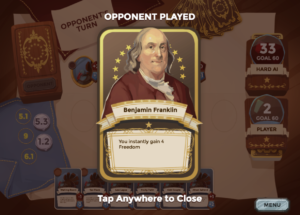
A challenging, fun card game that helps students learn about their rights under the Bill of Rights, the first 10 amendments to the Constitution.
LawCraft
Learn how laws are made in an updated version of LawCraft. Select a district to represent in the House of Representatives, then review letters from constituents. You’ll dig into survey data and select an issue that’s important to you and the people who live in your district. Take that issue to the House and jump into the law-making process. See if you can make the compromises necessary to get your bill passed by the House and Senate and still make a law you’re proud of.
Sixth Amendment Interactive
This tool allows students to explore the rights the Sixth Amendment grants to defendants in criminal trials by linking the text’s most debated clauses to expert knowledge on their various interpretations.
Executive Command
Who wants to be President? Players must use their multitasking skills as they consider bills to sign, fly off for diplomatic meetings and act as commander-in-chief to handle a military crisis.
Court Quest
In this new version of Court Quest, jump on the Justice Express and help guide ordinary citizens who are looking for justice through local, state and federal court systems.
Branches of Power
This game immerses students in the workings of our three branches of government. Players take on the roles of legislator, president and Supreme Court justice to get constitutional laws enacted. Players juggle several bills at once while holding press conferences and town hall meetings.
Planned Parenthood
Planned Parenthood describes itself as “a visible and passionate advocate for policies that enable Americans to access comprehensive reproductive and sexual health care, education, and information.”